
About
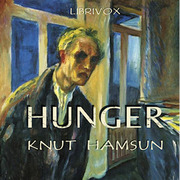
LibriVox recording of Hunger, by Knut Hamsun. Read by Greg W. Hunger (Norwegian: Sult) is a novel by the Norwegian author and Nobel Prize winner Knut Hamsun and was published in its final form in 1890. The novel has been hailed as the literary opening of the 20th century and an outstanding example of modern, psychology-driven literature. It hails the irrationality of the human mind in an intriguing and sometimes humorous novel. Written after Hamsun's return from an ill-fated tour of America, Hunger is loosely based on the author's own impoverished life before his breakthrough in 1890. Set in late 19th century Kristiania, the novel recounts the adventures of a starving young man whose sense of reality is giving way to a delusionary existence on the darker side of a modern metropolis. While he vainly tries to maintain an outer shell of respectability, his mental and physical decay are recounted in detail. His ordeal, enhanced by his inability or unwillingness to pursue a professional career, which he deems unfit for someone of his abilities, is pictured in a series of encounters which Hamsun himself described as 'a series of analyses.' In many ways, the protagonist of the novel displays traits reminiscent of Raskolnikov, whose creator, Fyodor Dostoevsky, was one of Hamsun's main influences. The influence of naturalist authors such as Emile Zola is apparent in the novel, as is his rejection of the realist tradition.(Introduction by Wikipedia) For further information, including l
Listen online
Chapter 1 / 14
01 - Part I
Total duration: 6:47:00
The author

Knut Hamsun
Knut Hamsun (; Norwegian: [ˈhɑmsʉn]; 4 August 1859 – 19 February 1952) was a Norwegian writer who was awarded the 1920 Nobel Prize in Literature for his novel Growth of the Soil. Hamsun's work spans more than 70 years and shows variation with regard to consciousness, subject, perspective and environment. He published more than 23 novels, a collection of poetry, some short stories and plays, a travelogue, works of non-fiction and some essays. Hamsun is considered "one of the most influential and innovative literary stylists of the past hundred years" (c. 1890–1990). He pioneered psychological literature with techniques of stream of consciousness and interior monologue, and influenced authors such as Thomas Mann, Franz Kafka, Maxim Gorky, Stefan Zweig, Henry Miller, Hermann Hesse, John Fante, James Kelman, Charles Bukowski and Ernest Hemingway. Isaac Bashevis Singer called Hamsun "the father of the modern school of literature in his every aspect—his subjectiveness, his fragmentariness, his use of flashbacks, his lyricism. The whole modern school of fiction in the twentieth century stems from Hamsun". Since 1916, several of Hamsun's works have been adapted into motion pictures. On 4…
See all their booksMore novels
Reviews & ratings
No reviews yet. Be the first!
Books like this one