Informazioni
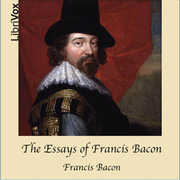
Voltaire was an atheist. Diderot was Enlightened. But trite titles seldom encompass completely the beliefs of any individual. And this one fact is certainly true when dealing with Sir Francis Bacon.The youngest son of Sir Nicholas Bacon, Francis was born in Strand, London, on Jan. 22, 1561. He went to Trinity College at Cambridge. He was elected to Parliament; he was Queen's Counsel; he even became Attorney General before finally gaining the position of Lord Chancellor.But as do the careers of so many politicians, in 1621 his political career ended in disgrace.And yet, for all of this, both Diderot and Voltaire considered him "the father of modern science." Others consider him only the father of the "scientific method." (That process of collecting and organizing data.) Bacon's "The Essays," to which we now turn our attention, are--if they are nothing else--a delightful collection in decided disarray. That is, they seem to take no true progression. But an essay is not meant to be a treatise. And for all that, these essays are still a pleasure to read.Encompassing a broad field of interest, their largesse denotes the broad learning of this brilliant philosopher. It is therefore our sincere hope that the reader will, themselves, encompass these Essays. More importantly, we hope you enjoy them. (Summary by Carl Vonnoh, III) For further information, including links to online text, reader information, RSS feeds, CD cover or other formats (if available), please go to the LibriVox ca
Ascolta online
Capitolo 1 / 14
The Essays of Francis Bacon 01
Durata totale: 6:17:08
L'autore

Francis Bacon
Francis Bacon, italianizzato in Francesco Bacone (Londra, 22 gennaio 1561 – Londra, 9 aprile 1626), è stato un filosofo, politico, giurista e saggista inglese vissuto alla corte inglese. Fu Procuratore generale e Lord cancelliere sotto il regno di Giacomo I Stuart. Formatosi con studi in legge e giurisprudenza, divenne uno strenuo difensore della rivoluzione scientifica, su cui le sue opere ebbero una importante e duratura influenza, sostenendo il metodo induttivo fondato sull'esperienza, in senso gnoseologicamente contrapposto al futuro metodo deduttivo posto da René Descartes quasi mezzo secolo dopo. Il suo approccio è anche alla base della futura teoria lockiana della tabula rasa (con questa espressione, già a partire da Platone, seguito da Aristotele, si esprime il rifiuto della concezione secondo cui l'essere umano, già dalla nascita, abbia in sé delle idee innate, dei contenuti di conoscenza che non derivano dall'esperienza.
Vedi tutti i suoi libriAltri libri di filosofia
Recensioni e voti
Ancora nessuna recensione. Scrivi la prima!
Libri simili