
Acerca del libro
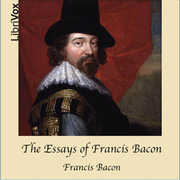
Voltaire was an atheist. Diderot was Enlightened. But trite titles seldom encompass completely the beliefs of any individual. And this one fact is certainly true when dealing with Sir Francis Bacon.The youngest son of Sir Nicholas Bacon, Francis was born in Strand, London, on Jan. 22, 1561. He went to Trinity College at Cambridge. He was elected to Parliament; he was Queen's Counsel; he even became Attorney General before finally gaining the position of Lord Chancellor.But as do the careers of so many politicians, in 1621 his political career ended in disgrace.And yet, for all of this, both Diderot and Voltaire considered him "the father of modern science." Others consider him only the father of the "scientific method." (That process of collecting and organizing data.) Bacon's "The Essays," to which we now turn our attention, are--if they are nothing else--a delightful collection in decided disarray. That is, they seem to take no true progression. But an essay is not meant to be a treatise. And for all that, these essays are still a pleasure to read.Encompassing a broad field of interest, their largesse denotes the broad learning of this brilliant philosopher. It is therefore our sincere hope that the reader will, themselves, encompass these Essays. More importantly, we hope you enjoy them. (Summary by Carl Vonnoh, III) For further information, including links to online text, reader information, RSS feeds, CD cover or other formats (if available), please go to the LibriVox ca
Escuchar en línea
Capítulo 1 / 14
The Essays of Francis Bacon 01
Duración total: 6:17:08
El autor

Francis Bacon
Francis Bacon, primer barón de Verulamium, primer vizconde de Saint Albans y canciller de Inglaterra (Strand, Londres, 22 de enero de 1561-Highgate, Middlesex, 9 de abril de 1626) fue un filósofo, político, abogado y escritor inglés, padre del empirismo filosófico y científico. En su Novum organum (1620) precisó las reglas del método científico experimental, y desarrolló en su De dignitate et augmentis scientiarum (Sobre la dignidad y progresos de las ciencias) (1620) una teoría empírica del conocimiento, lo que hizo de él uno de los pioneros del pensamiento científico moderno. Asimismo, introdujo el género del ensayo en Inglaterra.
Ver todos sus librosMás de filosofía
Opiniones y valoraciones
Todavía no hay opiniones. ¡Sé el primero!
Libros como este