
About
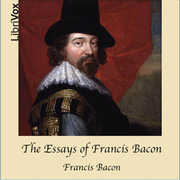
Voltaire was an atheist. Diderot was Enlightened. But trite titles seldom encompass completely the beliefs of any individual. And this one fact is certainly true when dealing with Sir Francis Bacon.The youngest son of Sir Nicholas Bacon, Francis was born in Strand, London, on Jan. 22, 1561. He went to Trinity College at Cambridge. He was elected to Parliament; he was Queen's Counsel; he even became Attorney General before finally gaining the position of Lord Chancellor.But as do the careers of so many politicians, in 1621 his political career ended in disgrace.And yet, for all of this, both Diderot and Voltaire considered him "the father of modern science." Others consider him only the father of the "scientific method." (That process of collecting and organizing data.) Bacon's "The Essays," to which we now turn our attention, are--if they are nothing else--a delightful collection in decided disarray. That is, they seem to take no true progression. But an essay is not meant to be a treatise. And for all that, these essays are still a pleasure to read.Encompassing a broad field of interest, their largesse denotes the broad learning of this brilliant philosopher. It is therefore our sincere hope that the reader will, themselves, encompass these Essays. More importantly, we hope you enjoy them. (Summary by Carl Vonnoh, III) For further information, including links to online text, reader information, RSS feeds, CD cover or other formats (if available), please go to the LibriVox ca
Listen online
Chapter 1 / 14
The Essays of Francis Bacon 01
Total duration: 6:17:08
The author

Francis Bacon
Francis Bacon, 1st Viscount St Alban (; 22 January 1561 – 9 April 1626) was an English philosopher and statesman who served as Attorney General and Lord Chancellor of England under King James I. Bacon argued for the importance of natural philosophy, guided by the scientific method, and his works remained influential throughout the Scientific Revolution. Bacon has been called the father of empiricism. He argued for the possibility of scientific knowledge based only upon inductive reasoning and careful observation of events in nature. He believed that science could be achieved by the use of a sceptical and methodical approach whereby scientists aim to avoid misleading themselves. Although his most specific proposals about such a method, the Baconian method, did not have long-lasting influence, the general idea of the importance and possibility of a sceptical methodology makes Bacon one of the founders of the scientific method. His portion of the method based in scepticism was a new rhetorical and theoretical framework for science, whose practical details are still central to debates on science and methodology. He is famous for his role in the scientific revolution, promoting…
See all their booksMore philosophy
Reviews & ratings
No reviews yet. Be the first!
Books like this one