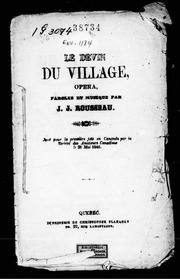
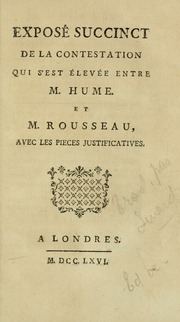
Exposé succinct de la contestation qui s'est élevée entre M. Hume. et M. Rousseau : avec les pieces justificatives
- Language
- Français
- Pages
- 160
- Downloads
- 1
About
First part of imprint false. Actual place of printing from Weller. Cf. also "David Hume and the 18th century British thought", Tokyo, 1986 An account sent by Hume to friends in Paris, to be prepared for publication; edited, and the English portions translated by J.B.A. Suard. Later in the same year Hume supervised the issue of an English version with title: A concise and genuine account of the dispute between Mr. Hume and Mr. Rousseau. cf. Hill, G.B., ed. Letters of David Hume "Déclaration adressée par M. d'Alembert aux éditeurs": p. 125-127 One of several issues of the same year Weller, E.O. Falsche Druckorte Fisher Walsh copy: Bound with the author's Pensées philosophiques, morales, critiques, littéraires et politiques. Londres [i.e. Paris], 1767 32
The author

Jean-Jacques Rousseau
Jean-Jacques Rousseau (UK: , US: ; French: [ʒɑ̃ʒak ʁuso]; 28 June 1712 – 2 July 1778) was a Genevan philosophe, writer, and composer. His political philosophy was influential during the Age of Enlightenment, as well as during the French Revolution. Rousseau wrote Discourse on Inequality, which argues that private property is the source of social inequality, and The Social Contract, which outlines his ideas for what makes a legitimate political order. Rousseau's sentimental novel Julie, or the New Heloise (1761) was an example of his contributions to preromanticism and romanticism in fiction. His Émile, or On Education (1762) is a treatise on the place of the individual in society. Rousseau also wrote some autobiographical writings, such as the posthumously published Confessions (completed in 1770), and the unfinished Reveries of the Solitary Walker (composed 1776–1778)—,which featured an increased focus on subjectivity and introspection. He is thought to be one of the influences on the late 18th-century "Age of Sensibility."
See all their booksBy the same author
More novels
Reviews & ratings
No reviews yet. Be the first!
Books like this one